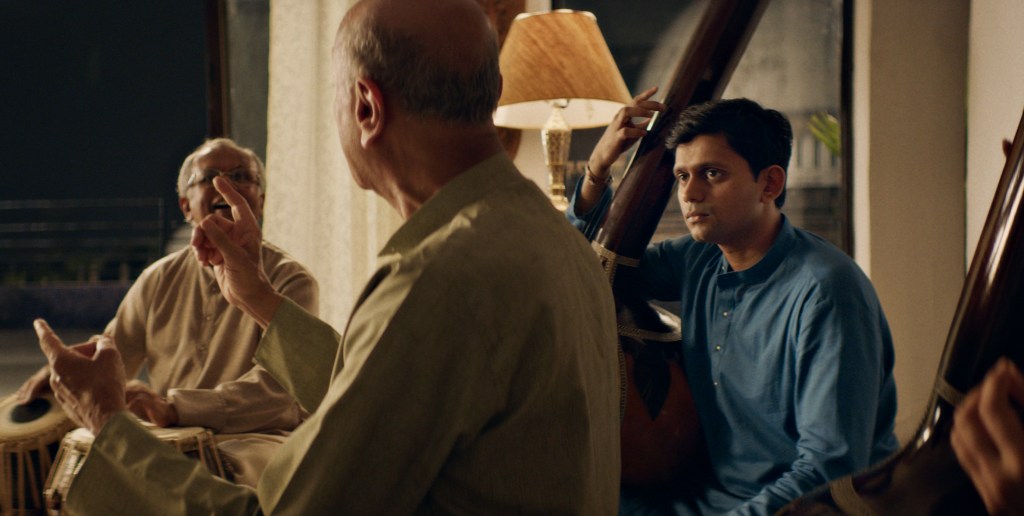
Chaitanya Tamhane opens his second feature with a cut from the black, with what sounds like a slow warbling of Indian Classical Music playing, to the establishment shot of people listening in bliss to the masterful presentation of Śāstriya Saṅgīt (Northern Indian Classical Music a.k.a Hindustani Music). The next cut, the camera sits with the musicians. The lead performer is the master of the students who accompany playing instruments along with the other professionals in his performances. The camera slowly moves in, our attention is slowly shifting as well to focus on one of the students named Sharad Nerulkar, a young and vibrant musician in his mid-20s, enjoying his master’s effortless rendition of a divine Raag (one of the two fundamental elements of Hindustani music) with great admiration.
All it took for Tamhane who is also the editor of the film here was just 90 secs to establish the lead character of the film. He’s young, not only by age but in the art of Hindustani music as well. He admires and respects his guru, and therefore, the art and his musical ambitions are high. Another interesting aspect of this opening scene is the first shot, a high angle view of the performance covering the audience and the musicians as if to signify how sacred the art of Indian Classical Music is considered and practiced and in its eyes, there is no difference. No one is high when compared to the art, neither the master nor the students, they all are equal.
Nerulkar, like most of us, is a simple dreamer. His late father was a failed Hindustani musician and he tries hard not to end up like his father. Part of that asceticism is getting obsessed with the unpublished recording of lectures on what it takes to be a Hindustani musician by Maai, the guru of Nerulkar’s master. He even gets selfish and acts as if he’s completely unaware of any kind of such recordings when one of his friends talks about it. These recordings are presented as voice-overs and the way it’s written is one of many examples of brilliance in Tamhane’s screenwriting. The voice-over happens only when Nerulkar travels but the interesting aspect of it is that the roads are always empty. We never see the stopping point and the shot design is frontal medium signifying that he’s following the art in a lifelong journey, a long & lonely spiritual path where you can see the invisible and an eternal quest of life and in turn the discovery of oneself.
But, for Nerulkar it seems maybe the art doesn’t love him back as much as he loves it. We see scene after scene, the screen is filled with nothing but disappointments. The disappointment, of not being able to win not even the last prize in a local singing competition, and from the feeling of art failing him despite all the practices and meditation in trying to take control of his mind and his art. He gets too distracted, by the failures, and has all the common problems of every Indian youngster & indulges in porn not realizing that art fails no one, and the only thing that’s not letting him reach his ambitions is himself. His mind is so restless and the concentration, the indispensable mind control for an artist is lacking.
With the help of his guru an opportunity for a solo performance comes his way and this is where the film gets even more interesting. Tamhane never shows scenes of Nerulkar practicing, there’s a reason for it and I will come to that later. Nerulkar performs really well and we get a recurring pattern in writing here. He travels by his bike and we hear the same voice-over again but this time, the design of it is that it’s a backward shot instead of a frontal shot, art starting to follow him, or at least that’s what he’s thinking of his music. As the years go by, Nerulkar in his mid-30s faces the harsh reality, he works as a teacher in one of the local music schools for a living, his occasional musical events are not successful. Seeing his friends successful by leading a happy life unlike him, and reading negative comments on youtube saying that his renditions are bland & not improvised, are not helping him either. He is on the verge of ending up as a failure like his father, if not already.
Remember I mentioned that Tamhane didn’t show scenes of Nerulkar practicing?. That is ‘cause he’s been practicing the same exact thing for so many years and if he performs well in the upcoming event. He performed well only ‘cause he may have perfected one of the Raags he’s been practicing all his life but not the art of the Hindustani music which requires artists to improvise and create their own Raags spontaneously. If he in fact, actually did perfect the art, he wouldn’t be struggling when we saw him totally transformed, both physically and mentally, years after that performance.
Reality is becoming the worst enemy for Nerulkar, through television, he sees that the world of music is changing, everything has become a matter of glamor now and there’s no real hope a struggling artist like him can cling onto. During one of his performances when he tries to improvise with the Raagb, but he couldn’t and the realization that he’s not good enough hits him like a wave-current hitting the hard mountain rocks, he gives up and succumbs to despair. After all, one can meander in his own mind feeling cream crackered all his life for only so long when the mind itself is tortured in the first place. Now, the climax is a little devastating but at the same time. It’s subtly beautiful in a way that it gives hope, and that maybe art doesn’t follow everyone but, life, as always, still goes on.
Thanks for reading. Cheers.
 CiNeMA ReTroSpecT